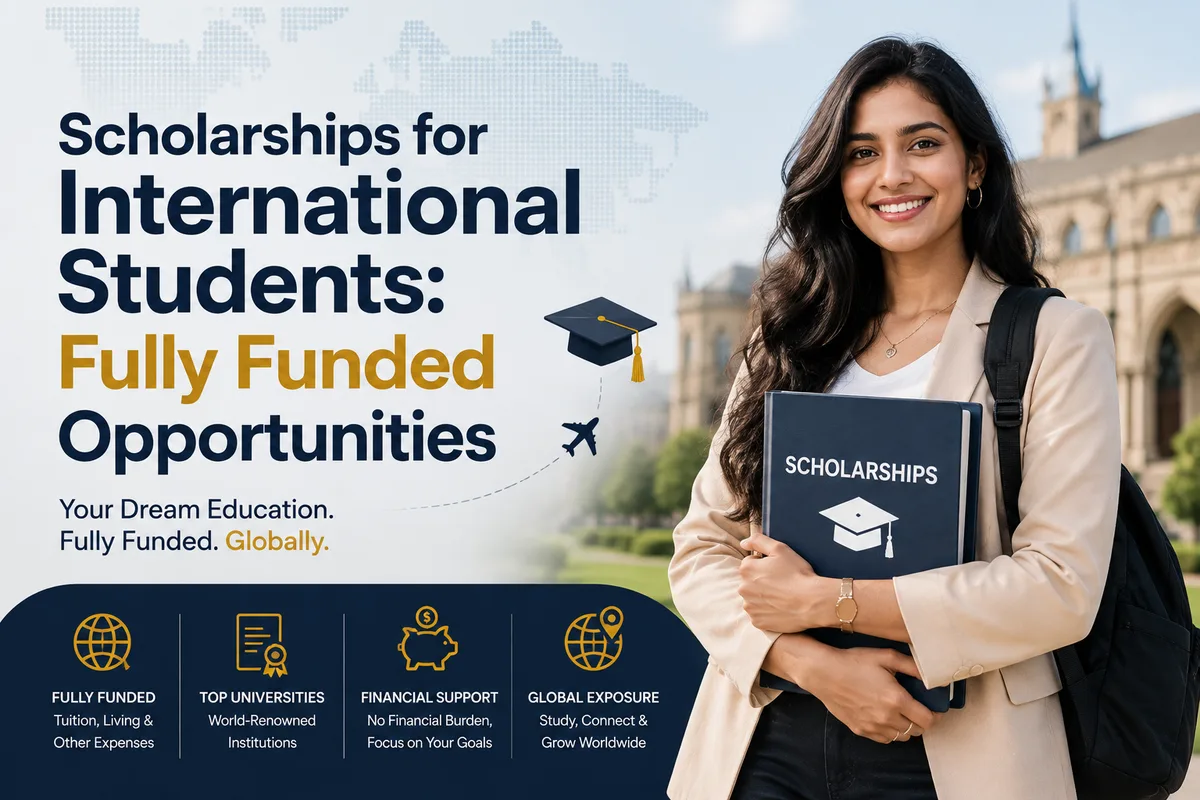
Discover comprehensive scholarships for international students to transform your education dream into reality. Learn how to apply for fully funded opportunities in the UK and Europe. Pursuing a university degree overseas is a transformative experience, offering unparalleled academic opportunities and profound cultural enrichment. However, the financial reality of studying abroad—especially amidst rising living costs —can feel deeply daunting for prospective scholars. The landscape in particularly competitive, driven by a surge of pent-up demand following years of global travel restrictions. As such, preparation is more vital than ever. Fortunately, scholarships for international students provide a vital lifeline. They have the power to transform international education from a distant dream into an achievable reality. Whether you are a secondary school graduate seeking a bachelor's degree, or an established professional hunting for postgraduate research opportunities, this guide will explore the landscape of international scholarships available. We will uncover where to look, how to apply, and what it truly takes to secure these highly competitive awards.
Before you begin filling out application forms, it is crucial to understand the remarkably diverse landscape of financial assistance. Universities, national governments, and private organisations offer various forms of support, each with distinct criteria. A frequent query from applicants is: can international students get full ride scholarships? The answer is a resounding yes, though they are exceptionally competitive. These prestigious awards are the holy grail of educational funding. They typically cover the entirety of your tuition fees, university accommodation, return flights, and even provide a monthly allowance. You will often see these life-changing opportunities advertised as fully funded scholarships for international students. When browsing programmes, it is imperative to understand the distinction between merit-based vs need-based funding. Merit-based awards are granted strictly to candidates with outstanding academic, athletic, or artistic achievements, regardless of their financial background. If you are a top-tier student with a track record of excellence, these are your primary targets. Conversely, need-based aid focuses predominantly on a student's demonstrated financial hardship, assessing family income to determine who genuinely requires support. Furthermore, while many assume comprehensive funding is reserved solely for postgraduates, there are numerous fully funded undergraduate awards available globally. Institutions frequently offer need-blind admissions with full financial support for exceptional undergraduates, whilst specific trusts sponsor younger scholars displaying immense potential.
1.Global Hotspots for Educational Funding
Knowing where to look is half the battle. Different countries have entirely different approaches to funding international talent.
2.The United Kingdom
The UK remains a sought-after destination for global scholars. If you are wondering how to get scholarship in uk, the key lies in starting your research early. The British government and universities offer generous packages. For instance, masters scholarships uk—such as the world-renowned Chevening Scholarships—provide fully funded packages for future leaders to study at participating universities. Beyond Chevening, prospective applicants should also investigate the GREAT Scholarships programme, which offers substantial financial support to students from designated countries across various academic disciplines. Furthermore, numerous institutions offer specific english scholarships; these might be aimed at students originating from Commonwealth nations, or grants designed for those undertaking advanced studies in English Literature and Linguistics.
3.Continental Europe and Beyond
If you are looking further afield, masters scholarships in europe are incredibly attractive and often less oversubscribed. Programmes like the European Union's Erasmus+ scheme allow students to study across multiple countries, offering a pan-European academic experience. Additionally, several European nations consistently rank amongst the best countries for tuition-free education. Places like Germany and Norway historically offer very low or zero tuition fees at public universities, even for non-EU students. In these instances, you technically only need to secure funding for your daily living costs. To maximise your chances, learn how to find country-specific government grants. Websites like the DAAD (German Academic Exchange Service) or Campus France are excellent starting points. Do not rely solely on university aid; actively seek out external funding sources for foreign masters students. These include philanthropic foundations, corporate sponsorships, and international charities.
4.Crafting a Stellar Application
Securing funding requires more than just good grades; it demands meticulous preparation and strategic thinking.
5.Eligibility and Academic Transcripts
First, review the eligibility criteria for non-resident financial aid with a fine-tooth comb. Every scheme has strict parameters regarding eligible nationalities, subject areas, and required academic history. Speaking of academics, never underestimate the profound impact of GPA on study abroad funding. Most merit-based panels use your Grade Point Average (or your home country's specific equivalent) as the primary filtering mechanism. To ensure your grades are properly understood by foreign institutions, you will frequently need to utilise professional academic transcript evaluation services. Organisations such as UK ENIC in Britain can formally translate your local qualifications into the destination country's grading system.
6.Language Requirements and Essay Writing
Another crucial hurdle is language proficiency. Always verify the specific English language proficiency requirements for grants. Even if you possess an unconditional offer of study, specific scholarship bodies may demand a significantly higher IELTS or TOEFL score. They do this to guarantee that scholars can effortlessly handle rigorous academic environments. Furthermore, secure your letters of recommendation well in advance. Choose academic referees who can speak specifically to your strengths, work ethic, and suitability for the scholarship, rather than those who can only provide a generic character reference. Finally, mastering how to write a winning scholarship essay is arguably the most valuable skill you can develop. Your personal statement must transcend your standard CV.
- Be authentic: Share your personal narrative and what genuinely drives your passion.
- Demonstrate tangible impact: Funder organisations view you as an investment. Explain how this specific funding will equip you to contribute meaningfully to your home country upon graduation.
- Tailor every application: Never use a generic essay. Customise each application to align perfectly with the specific funder's stated core values and objectives.
7.Managing Logistics: Visas, Deadlines, and Living Costs
Securing a scholarship fundamentally impacts your legal ability to study abroad. When you apply for your student visa, immigration authorities will require concrete proof of financial support for student visa approval. Without this, your visa will be denied. An official scholarship award letter serves as the perfect documentation. Furthermore, you must be absolutely clear about what your grant covers. Look very closely at the stipends and living expenses coverage. Will the promised monthly stipend comfortably cover rent, groceries, and transport in your chosen city? London, for example, is notoriously expensive, so you must budget meticulously and realistically. If your stipend falls short, you must research visa regulations regarding part-time employment. Many countries allow international students to work up to twenty hours per week during term time, which can critically supplement your income and ease financial pressure. Organisation throughout this journey is paramount. You are strongly advised to create a comprehensive digital deadline calendar for university fellowships. Scholarship deadlines frequently fall many months before the actual university course application deadlines. Missing a funding cutoff date by a single day usually means automatic disqualification.
8.Steering Clear of Application Pitfalls
Every year, brilliant students miss out on funding due to preventable errors. Recognising common mistakes in global education applications can give you an immediate advantage:
- Ignoring strict instructions: Failing to adhere to formatting rules or specified word counts often results in your application being discarded instantly.
- Presenting vague career goals: Scholarship boards want to invest in driven future leaders with actionable career trajectories, not someone merely wanting an extended holiday abroad.
- Applying to only one source: This is a remarkably high-risk strategy. Relying on a single source of scholarships for international students dramatically reduces your chances. Apply for university grants, government schemes, and external foundations simultaneously.
- Submitting unpolished work: Submitting applications riddled with spelling or grammatical errors demonstrates a lack of care. Proofread meticulously and always use British English if applying to UK institutions.
🎓 Turn Your Study Abroad Dream into a Scholarship Success Story
Studying abroad doesn't have to be financially overwhelming. With the right scholarship opportunities and expert guidance, you can access world-class education while significantly reducing your expenses.
At Cokonet Overseas, we help students identify the best international scholarships, choose the right universities, prepare winning applications, and navigate every step of the admission and visa process.
9.Why Choose Cokonet Overseas?
Expert UK university counselling
- Affordable university recommendations
- Scholarship and financial aid guidance
- Complete admission assistance
- Student visa documentation support
- Education loan assistance
- Accommodation guidance
- Pre-departure and post-arrival support
Website: https://cokonetoverseas.com/
Kochi:
Trivandrum:
10.Final Thoughts
Securing international educational funding in 2023 is a rigorous endeavour. It requires a significant investment of time, resilience in the face of rejections, and strategic planning. However, the ultimate reward—obtaining a world-class education without the burden of long-term debt—is entirely worth the sacrifice. By fully understanding the types of aid available, preparing your documentation properly, and submitting tailored essays, you can navigate the global funding landscape successfully. Start your research today, stay relentlessly organised, and take that first bold step towards realising your international academic journey.