Embarking on a doctoral journey is a monumental decision, demanding intense dedication and substantial financial planning. For many aspiring researchers, pursuing a phd in uk for indian students represents a premier academic achievement. The United Kingdom possesses a historic reputation for educational excellence, housing globally prestigious institutions, state-of-the-art laboratories, and a centuries-old tradition of ground-breaking research. The deep-rooted educational ties between India and the UK further enhance this appeal, fostering an environment where Indian scholars consistently thrive and lead impactful global research initiatives.
If you are amongst the growing cohort of indian students abroad, the UK offers an unparalleled academic ecosystem. The incredibly vibrant community of indian students uk ensures a welcoming environment, seamlessly blending cultural familiarity with global diversity. This comprehensive guide explores top institutions, admission intricacies, funding landscapes, and absolutely everything needed to successfully navigate your doctoral ambitions in Britain.
1.Why Pursue a Doctorate in the United Kingdom?
A primary advantage of a phd in uk is the streamlined, highly focussed structure of the programmes. Unlike the North American model, which often requires extensive coursework before transitioning to independent research, the British system is heavily research-focussed from day one. Consequently, the standard phd duration in uk is typically three to four years of full-time study. This concise timeframe allows researchers to enter academia or the corporate workforce much sooner, saving both valuable time and living expenses.
Before committing to an application, candidates frequently wonder about the difference between MPhil and PhD in UK institutions. An MPhil (Master of Philosophy) is a shorter, advanced research degree, usually completed in two years. However, in most UK universities, first-year doctoral students initially enrol on an MPhil track. At the end of year one, you must pass a rigorous upgrade panel to officially transition to full PhD status.
2.Premier Institutions for Indian Scholars
Choosing the exact right university requires a delicate balance of academic prestige, available resources, and supervisory expertise. Elite institutions consistently attracting top talent from India include:
1. University of Oxford and University of Cambridge
Affectionately known as 'Oxbridge', these ancient universities represent the absolute pinnacle of higher education, offering unmatched archives and Nobel-laureate faculties. Whether you are investigating advanced quantum physics or exploring centuries of South Asian colonial history, their resources are entirely unparalleled. Securing a spot is highly competitive, requiring an outstanding academic record and a flawlessly constructed proposal.
2. Imperial College London
For STEM (Science, Technology, Engineering, and Mathematics) disciplines, Imperial College is a global powerhouse. International applicants aiming for sensitive scientific or engineering research here must acquire an Academic Technology Approval Scheme certificate (ATAS) prior to applying for their visa.
3. University College London (UCL)
Situated in the heart of the capital, UCL champions a multi-disciplinary research approach. It is exceptionally renowned for medical sciences, humanities, and social sciences. They offer immense support networks specifically designed to help international students integrate seamlessly into the fast-paced London academic scene.
4. University of Edinburgh
Scotland’s premier institution is globally celebrated for informatics, literature, and biological sciences. Edinburgh actively participates in several doctoral training partnerships in UK (DTPs). These UKRI-funded collaborative networks offer bespoke training, interdisciplinary supervision, and highly robust funding packages.
4.Funding Your Research Journey
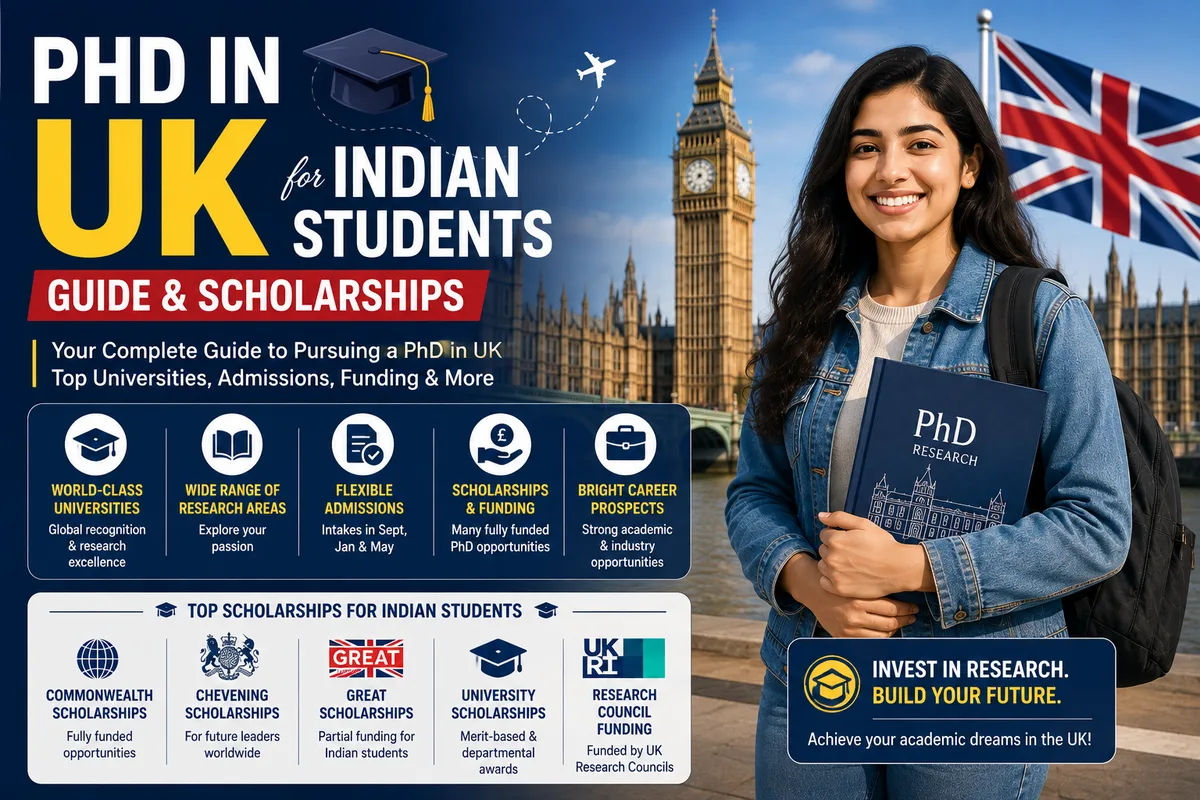
Financial planning is often daunting, yet the UK actively offers targeted phd scholarships for indian students in uk. While some candidates self-fund, most fiercely aspire to secure fully funded PhD programs for international students, which generously cover international tuition fees and provide a tax-free monthly living stipend.
It is vital to remember that funding applications often close months before the academic year begins. Therefore, beginning your search up to twelve months in advance is highly recommended to ensure you do not miss critical deadlines.
When exploring phd scholarships uk, several high-profile funding bodies stand out prominently:
- Commonwealth Scholarships: Funded by the UK government, these are globally prestigious. Review the Commonwealth Scholarship for Indian students eligibility criteria meticulously; candidates must demonstrate an exceptional academic track record and propose research actively contributing to their home country's sustainable development.
- GREAT Scholarships: Launched in partnership with the British Council, the GREAT scholarships for Indian students offer substantial financial contributions towards tuition fees across various academic subjects, fostering strong bilateral ties.
- Charles Wallace India Trust Fellowships: For specific research involving arts, humanities, or heritage conservation, the Charles Wallace India Trust fellowships provide highly bespoke grants. These directly enable Indian academics to access exclusive British archives and collaborate with renowned UK practitioners.
- University-Specific Grants: Many top-tier universities offer their own internal bursaries and vice-chancellor awards exclusively for international postgraduates, which can significantly offset the burden of tuition costs.
5.Visas, Logistics, and Living Costs
Thorough logistical preparation ensures a completely smooth transition to your new life in Britain.
Calculating Expenses
A pragmatic, realistic understanding of the cost of living in UK for international students is absolutely imperative. London and the broader South East are notably expensive; confidently budget roughly £1,300 to £1,600 per month for rent, utilities, groceries, and transport. Conversely, cities in the North of England (like Leeds or Sheffield), Scotland, and Wales are far more affordable, averaging between £900 and £1,100 monthly.
Visa Requirements
Navigating the UK student visa requirements for Indian citizens is a straightforward process once you receive your Confirmation of Acceptance for Studies (CAS). You must provide biometric data, pay the Immigration Health Surcharge (granting full National Health Service access), and prove sufficient funds for tuition and living costs for nine months. Ensure your bank statements are in the correct format as specified by UK Visas and Immigration (UKVI) to avoid unnecessary processing delays. Additionally, prominently present your valid ATAS certificate if your research area demands it.
Post-Study Opportunities
A globally competitive feature of UK higher education is the post-graduation landscape. Upon successfully completing your doctorate, the Graduate Route visa UK post study work scheme allows you to legally remain in the UK for up to three years. This visa provides the essential flexibility to work, look for long-term corporate employment, or seamlessly undertake post-doctoral research without an immediate sponsor. This visa is particularly beneficial for those aiming to transition into British industry roles, allowing ample time to secure a Tier 2 (Skilled Worker) visa sponsorship down the line.
6.The Culmination: Defending Your Thesis
After years of intensive research, your journey brilliantly culminates in an oral examination. The viva voce examination process UK is a distinctive, rigorously upheld academic tradition. Unlike some international systems where public defences are common, the British 'viva' strictly occurs privately.
You will passionately defend your thesis before an internal examiner (from your university but never your supervisor) and an external examiner (a leading expert from another institution). They critically evaluate your methodology, scrutinise your findings, and determine your contribution's sheer originality. Passing officially marks your triumphant transition to a recognised, autonomous expert.
Why Choose Cokonet Overseas?
- Expert UK university counselling
- Affordable university recommendations
- Scholarship and financial aid guidance
- Complete admission assistance
- Student visa documentation support
- Education loan assistance
- Accommodation guidance
- Pre-departure and post-arrival support
Learn More:https://cokonetoverseas.com/destinations/uk
Website: https://cokonetoverseas.com/
7.Conclusion
Pursuing a doctorate in the United Kingdom is a profoundly transformative experience demanding unyielding resilience and strategic preparation. From identifying top-tier institutions and securing the exact right supervisor, to masterfully navigating complex scholarship applications and strict visa requirements, every step requires precise forethought.
For ambitious Indian scholars, the UK provides an absolutely exceptional platform. The seamless combination of world-class infrastructure, cosmopolitan cultural hubs, and robust post-study work opportunities creates a uniquely compelling proposition. By thoroughly researching your options, drafting persuasive proposals, and aggressively leveraging funding networks, joining the global academic elite is entirely within reach.
Start your preparation today by refining your academic narrative and reaching out to potential mentors. The historic libraries, cutting-edge laboratories, and grand lecture halls of Britain's finest universities are eagerly waiting for your brilliant academic contribution.